

What follows are edited segments from several broadcast interviews with Megan, in studio, shortly after the murder of my Mother. Megan ran with the crowd that killed my Mother and was a user of all types of street drugs. She was beaten about the face and head by Amanda K. Lane with a piece of rubber hose shortly before my Mother was beaten with a baseball bat. Megan has since beaten her drug habit and is on the road to being a law abiding and useful citizen. She did these interviews in an effort to warn parents and users alike that drugs are a dead end.
 CLICK
HERE to hear the first audio on demand segment featuring an interview
between her and Jerry Pippin shortly after the murder. Amanda Kay had beaten her up with a metal pipe just
weeks before the beating death of my mother.
CLICK
HERE to hear the first audio on demand segment featuring an interview
between her and Jerry Pippin shortly after the murder. Amanda Kay had beaten her up with a metal pipe just
weeks before the beating death of my mother.
 CLICK HERE to hear the
second of three segments.
CLICK HERE to hear the
second of three segments.
CLICK HERE to hear the third of three segments.
A long time friend of Jerry's and a contributor to this web site also has a similar message for young people in trouble. Click here to hear Jerry's interview with T. Suzanne Eller. Suzanne has a new book out titled, "Real Teens, Real Stories, Real Life." In this interview, Jerry visits with her about her troubled teen life, and how she views this as a mission to help teenagers in today's tough world. Click here to find out more about Suzanne and to order her book, or order the book direct from Amazon.com.
Illegal Drugs Information - What are they?
 to find treatment, free of cost.
Many people do not know what options are available to them. We have
received a lot of positive feedback
Our guide can be found here:

Illegal Drug Information Resource Links - Where to get more information and
help
A Guide to Substance Abuse and Addiction Treatment
| DRUG TYPE | STREET NAME | LOOKS LIKE | DETECTABLE IN BODY |
HOW USED |
|---|---|---|---|---|
| Marijuana | Pot, Reefer, Grass, Weed, Dope, Ganja, Mary Jane, or Sinsemilla | Like dried parsley, with stems and/or seeds; rolled into cigarettes or cigars | 2 days to 11 wks | Smoked or eaten |
| Tetrahydrocannabinol | THC | Soft gelatin capsules | 2 days to 11 wks | Taken orally |
| Hashish | Hash | Brown or black cakes or balls | 2 days to 11 wks | Smoked or eaten |
| Hashish Oil | Hash Oil | Concentrated syrupy liquid varying in color from clear to black | 2 days to 11 wks | Smoked - mixed with tobacco |
| Nitrous Oxide | Laughing gas or Whippets | Small 8-gram metal cylinder sold with a balloon or pipe propellant for whipped cream in aerosol spray can | unknown | Vapors inhaled |
| Amyl Nitrite | Poppers or Snappers | Clear yellowish liquid in ampules | unknown | Vapors inhaled |
| Butyl Nitrite | Rush, Bolt, Bullet, Locker Room, and Climax | In small bottles | unknown | Vapors inhaled |
| Chlorohydrocarbons | Aerosol sprays or cleaning fluids | Aerosol paint cans | unknown | Vapors inhaled |
| Hydrocarbons | Solvents | Cans of aerosol propellants, gasoline, glue, paint thinner | unknown | Vapors inhaled |
| Cocaine | Coke, Snow, Nose Candy, Flake, Blow, Big C, Lady, White, and Snowbirds | White crystalline powder | 2 to 4 days | Inhaled, injected |
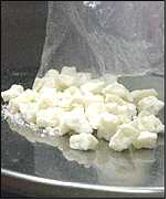
| Crack cocaine | Crack, rock, freebase | White to tan pellets or crystalline rocks that look like soap | 2 to 4 days | Smoked |
| Amphetamines | Speed, Uppers, Ups, Black beauties, Pep pills, Copilots, Bumblebees, Hearts, Benzedrine, Dexedrine, Footballs, and Biphetamine | Capsules, pills, tablets | 8 to 24 hours | Taken orally, injected, inhaled |
| Methamphetamines | Crank, Crystal meth, Crystal methadrine, and Speed | White powder, pills, rock that resembles a block of paraffin | 2 to 4 days | Taken orally, injected, inhaled |
| Additional Stimulants | Ritalin, Cylert, Preludin, Didrex, Pre-State, Voranil, Sandrex, and Plegine | Pills or capsules | 2 to 4 days | Taken orally, injected |
| Barbiturates | Downers, Barbs, Blue Devils, Red Devils, Yellow Jacket, Yellows, Nembutal, Tuinals, Seconal, and Amytal | Red, yellow, blue, or red and blue capsules | 2 to 10 days | Taken orally |
| Methaqualone | Quaaludes, Ludes, Sopors | Tablets | 2 wks | Taken orally |
| Tranquilizers | Valium, Librium, Miltown, Serax, Equanil, Miltown, and Tranxene | Tablets or capsules | 2 to 7 days | Taken orally |
| Phencyclidine | PCP, Hog, Angel Dust, Loveboat, Lovely | What does it look like - Liquid, white crystalline powder, pills, capsules | 2 to 8 days | Taken orally, injected, smoked (sprayed on joints or cigarettes) |
| Lysergic acid diethylamide | LSD, Acid, Microdot, White lightning, Blue heaven, and Sugar Cubes | Colored tablets, blotter paper, clear liquid, thin squares of gelatin | 8 hours | Taken orally, licked off paper, gelatin, and liquid can be put in the eyes. |
| Mescaline and Peyote | Mesc, Buttons, and Cactus | Hard brown discs, tablets, capsules | 2 to 3 days | Discs - chewed, swallowed, or smoked or Tablets and capsules - taken orally |
| Psilocybin | Magic Mushrooms, 'shrooms | Fresh or dried mushrooms | 6 hours | Chewed or swallowed |
| Heroin | Smack, Horse, Mud, Brown sugar, Junk, Black tar, and Big H | White to dark-brown powder or tarlike substance | 1 to 4 days | Injected, smoked, or inhaled |
| Codeine | Empirin compound with codeine, Tylenol with codeine, Codeine in cough medicine | Dark liquid varying in thickness, capsules, tablets | 1 to 2 days | Taken orally, injected |
| Morphine | Pectoral syrup | White crystals, hypodermic tablets, or injectable solutions | 1 to 3 days | Taken orally, injected, or smoked |
| Opium | Paregoric, Dover's Powder, Parepectolin | Dark brown chunks, powder | 1 to 2 days | Smoked, eaten, or injected |
| Meperidine | Pethidine, Demerol, Mepergan | White powder, solution, tablets | 1 to 2 days | Taken orally, injected |
| Other narcotics | Percocet, Percodan, Tussionex, Fentanyl, Darvon, Talwin, and Lomotil | Tablets or capsules | 8 to 24 hours | Taken orally, injected |
| Analog of Fentanyl (Narcotic) | Synthetic heroin, China white | White powder | unknown | Inhaled, injected |
| Analog of Meperidine (Narcotic) | MPTP (New heroin), MPPP, synthetic heroin | White powder | unknown | Inhaled, injected |
| Analog of Amphetamines or Methamphetamines (Hallucinogens) | MDMA (Ecstasy, XTC, Adam, Essence), MDM, STP, PMA, 2, 5-DMA, TMA, DOM, DOB, EVE | White powder, tablets, or capsules | unknown | Taken orally, injected, or inhaled |
| Analog of Phencyclidine (PCP) | PCPy, PCE | White powder | unknown | Taken orally, injected, or smoked |
ILLEGAL DRUGS INFORMATION RESOURCE LINKS
Organizations | Studies | Public Opinion Organizations
American Civil Liberties
Union Center for Substance
Abuse Research Center on Addiction
and Substance Abuse (CASA) Drug
Enforcement Administration Drug Policy Alliance Drug Strategies Hazelden Foundation Institute for a
Drug-Free Workplace Join Together National Clearinghouse for
Alcohol and Drug Information National Drug
Prosecution Center National Institute on
Drug Abuse National Organization for
the Reform of Marijuana Laws (NORML) Office of
National Drug Control Policy Rand
Corporation Drug Policy Research Center Sentencing
Project Substance Abuse and Mental
Health Services Administration U.S. Sentencing Commission University of Michigan
Institute for Social Research 2002
National Drug Control Strategy Adolescent
Self-Reported Behaviors and their Association with Marijuana Use The
National Survey of American Attitudes on Substance Abuse VI: Teens Behind
Bars: Substance Abuse and America's Prison Population
Organizations
The description of an organization is based on its own characterization of its
work.
Advocacy group that works to protect individual rights. Undertakes public
interest litigation and educates the public on a broad range of issues affecting
individual freedom in the United States.
125 Broad St., 18th Floor
New York, NY 10036
phone: (212) 549-2500
fax: (212) 549-2646
http://www.aclu.org
Ira Glasser, Executive Director
Loren Siegal, Public Affairs
Research center within the university's College of Behavioral and Social
Sciences that collects, analyzes, and disseminates information about the nature
and extent of substance abuse and related problems in Maryland, and nationally.
Also conducts policy-related research on initiatives to prevent, treat, and
control substance abuse.
University of Maryland
4321 Hartwick Rd., Suite 501
College Park, MD 20740
phone: (301) 403-8329
fax: (301) 403-8342
http://www.cesar.umd.edu/
Eric Wish, Director
Research center that works to inform the public of the cost of substance abuse
(legal and illegal drugs), and to encourage individuals and institutions to take
responsibility in fighting substance abuse.
Columbia University
633 Third Avenue, 19th floor
New York, NY 10017-6706
phone: (212) 841-5200
fax: (212) 956-8020
http://www.casacolumbia.org
Joseph Califano, Director
Alyse Booth, Public Affairs
Agency in the U.S. Department of Justice was assigned to enforce
controlled-substances laws and regulations.
700 Army-Navy Drive
Arlington, VA 22202
phone: (202) 307-7363
fax: (202) 307-7965
http://www.usdoj.gov/dea/index.htm
Thomas Constantine, Administrator
James McGivney, Public Affairs
A nonprofit organization that works to promote alternatives to the war on drugs,
including decriminalization and medical legalization, and an alternative
approach to drug policy and treatment that focuses on minimizing the adverse
effects of both drug use and drug prohibition. The Alliance was formerly known
as The Lindesmith Center - Drug Policy Foundation.
925 9th Ave
New York, New York 10019
phone: (212) 548-0695
fax: (212) 548-4670
http://www.drugpolicy.org
Ethan Nadelmann, Executive Director
Marsha Rosenbaum, Director, San Francisco Office
Nonprofit group dedicated to promoting more effective approaches to the nation's
drug problems, and to support private and public initiatives that reduce the
demand for drugs through prevention, education, treatment, and law enforcement.
1575 Eye Street, NW, Suite 210
Washington, D.C. 20005
phone: (202) 289-9070
fax: (202) 414-6199
http://www.drugstrategies.org
Mathea Falco, President
Sarah Duffy, Public Affairs
to find treatment, free of cost.
Nonprofit organization dedicated to helping people recover from substance
addiction. Provides residential and outpatient treatment, maintains programs for
families affected by chemical dependency, and publishes materials on addiction
and recovery issues.
PO Box 11
Center City, MN 55012-0011
phone: (612) 257-4010
fax: (612) 257-5101
http://www.hazelden.org
Jerry Spicer, Executive Director
Jeff Moravek, Public Affairs
Independent coalition that works to reduce the threat of drug abuse to the
business community - both employers and employees. Encourages drug testing and
employee assistance programs.
1225 Eye St., NW, Suite 1000
Washington, D.C. 20005
phone: (202) 842-7400
fax: (202) 842-0022
http://www.drugfreeworkplace.org
Mark deBernardo, Executive Director
Daryl G. Grecich, Director of Communications
A nonprofit organization that supports community-based efforts to reduce,
prevent and treat substance abuse.
441 Stuart St., 7th Floor
Boston, MA 02116
phone: (617) 437-1500
fax: (617) 437-9394
http://www.jointogether.org/sa/
David Rosenbloom, Project Director
Barbara Charton, Public Relations
Information service of the Department of Health and Human Services that makes
available research and statistics about substance abuse.
PO Box 2345
Rockville, MD 20847-2345
phone: (800) 729-6686
http://www.health.org
James Michie, Public Relations
A branch of the American Prosecutors Research Institute that trains prosecutors
to investigate and prosecute drug cases more effectively, evaluate drug control
and demand reduction strategies, and develop model drug laws.
99 Canal Center Plaza, Suite 510
Alexandria, VA 22314
phone: (703) 549-9222
fax: (703) 836-3195
http://www.ndaa-apri.org
Merri Hankins, Director
Supports and conducts research on drug abuse and addiction, and disseminates
findings to inform drug abuse and addiction prevention, treatment, and policy.
National Institutes of Health
6001 Executive Blvd
Bethesda, MD 20892-9561
phone: (301) 443-1124
http://www.nida.nih.gov
Alan Leshner, Director
Beverly Jackson, Public Affairs
Nonprofit foundation that advocates for the legalization of marijuana. Serves as
a clearinghouse for marijuana law reform efforts and information, and maintains
a legal affairs committee that will submit amicus curiae briefs in support of
those involved in important marijuana-related legal action at the appellate
court level.
1001 Connecticut Ave., NW, Suite 710
Washington, D.C. 20036
phone: (202) 483-5500
fax: (202) 483-0057
http://www.norml.org
Keith Stroup, Director
Paul Armenpano, Public Affairs
White House office that establishes policies and priorities for the nation's
drug control program, with the goal of reducing illicit drug use, manufacturing,
and trafficking. Creates the National Drug Control Strategy, which establishes a
budget and guidelines for cooperation among federal, state, and local
authorities
Washington, DC
phone: (202) 395-6618
fax: (202) 395-6724
http://www.whitehousedrugpolicy.gov
Barry McCaffrey, Director
Don Maples, Public Affairs

Research program that conducts empirical research, policy analysis, and outreach
so that community leaders and public officials develop more effective strategies
for dealing with drug problems. Its research includes projections of drug use
trends, assessments of local drug problems and responses, evaluations of
street-level drug markets, and comparative analyses of drug-related experiences
and policies of other countries.
1700 Main St.
PO Box 2138
Santa Monica, CA 90407-2138
phone: (310) 393-0411
http://www.rand.org/centers/dprc
Audrey Burnam and Barbara Williams, Co-Directors
Jess Cook, Public Affairs
A nonprofit organization that aims to improve sentencing practices by developing
sentencing programs that promote alternatives to incarceration, particularly for
indigent defendants.
514 - 10th Street, NW, Suite 1000
Washington, D.C. 20004
phone: (202) 628-0871
fax: (202) 628-1091
http://www.sentencingproject.org/
Malcolm Young, Executive Director
Marc Mauer, Public Affairs
Agency of the U.S. Department of Health and Human Services that works to assure
that the quality substance abuse and mental health services are available to
those who need them. Conducts the annual National Household Survey on Drug
Abuse.
5600 Fishers Lane, Suite 13C-05
Rockville, MD 20857
phone: (301) 443-8956
fax: (301) 443-9050
http://www.samhsa.gov
Nelba Chavez, Administrator
Mark Weber, Public Affairs
An independent agency in the judicial branch that establishes sentencing
policies and practices for the federal courts, including detailed guidelines
describing the appropriate form and severity of punishment for offenders
convicted of federal crimes. Also evaluates the effects of sentencing guidelines
on the criminal justice system, and recommends to Congress modifications of
criminal law and sentencing procedures.
1 Columbus Circle, NE
Washington, D.C. 20005-8002
phone: (202) 502-4500
http://www.ussc.gov
Richard Conaboy, Chair
Michael Courlander, Public Affairs
Research center that conducts the annual Monitoring the Future survey of teens
about substance use for the National Institute on Drug Abuse.
PO Box 1248
Ann Arbor, Michigan 48106-1248
phone: (313) 763-5043
fax: (313) 936-0043
http://www.isr.umich.edu/
Lloyd Johnston, Principal Investigator
published 2002
Office of National Drug Control Policy
phone: (202) 395-6618
fax: (202) 395-6724
http://www.whitehousedrugpolicy.gov/publications/policy/03ndcs/index.html
An outline of the nation's drug control strategy for the next decade. Includes
historical data on national drug control funding and administration.
published September 1998 in Analyses of Substance Abuse and Treatment Need
Issues
Substance Abuse and Mental Health Services Administration
Room 12-105 Parklawn Building
5600 Fishers Lane
Rockville, MD 20857
phone: 1-800-729-6686
http://www.samhsa.gov/PRESS/980922fs.htm
Found that adolescents, ages 12 to 17, who used marijuana in the past year were
more likely than nonusers to report problem behaviors.
published 2001
National Center on Addiction and Substance Abuse
Columbia University
152 West 57th St., 12th Floor
New York, NY 10019
phone: (212) 841-5200
fax: (212) 956-8020
http://www.casacolumbia.org/publications1456/publications_show.htm?doc_id=52809
Found that in 2000 cigarettes were harder to buy and marijuana was easier to buy
than in 1999 and that 28 percent of teenagers know a friend or classmate who has
used ecstasy.
published January 1998
The National Center on Addiction and Substance Abuse at Columbia University
152 West 57th St., 12th Floor
New York, NY phone: (212) 841-5200
fax: (212) 956-8020
http://www.casacolumbia.org/usr_doc/5745.pdf
Found that substance abuse was a factor in the crimes committed by 80 percent of
the prison inmates in the United States. The inmates had either violated drug or
alcohol laws, were high at the time they committed their crimes, stole to buy
drugs, have a history of substance abuse or some combination of factors. Also
found that inmates who were substance abusers were the most likely to be repeat
offenders.
Drug
Control: Status of Counternarcotics Efforts in Mexico
published March 1998
General Accounting Office
P.O. Box 6015
Gaithersburg, MD 20884
phone: (202) 512-6000
fax: (301) 258-4066
http://www.gao.gov/archive/1998/ns98129t.pdf
Found that despite U.S. and Mexican counternarcotics efforts, Mexico remains a
major source of heroin, methamphetamines and marijuana in the U.S., and a
primary transit country for cocaine coming to the U.S.
Drug
Control: Status of U.S. International Counternarcotics Activities
published March 1998
General Accounting Office
P.O. Box 6015
Gaithersburg, MD 20884
phone: (202) 512-6000
fax: (301) 258-4066
http://www.druglibrary.org/schaffer/GOVPUBS/gao/pdf5.pdf
Found that the U.S. has spent over $19 billion over the past ten years to curb
supply and demand for illegal drugs, yet use of illegal drugs, especially cocain
and heroin, is still a major public health problem.
Drug
Testing Index
published 2001
Quest Diagnostics Inc.
1 Malcolm Ave.
Teterboro, NJ 07608
phone: (201) 393-5597
http://www.questdiagnostics.com/brand/business/b_bus_lab_emp_drugtesting_index.html
Found that positive drug tests of American workers slightly increased to 5
percent in 2001, up from 4.9 percent in 2000.
Felony
Sentences in State Courts, 1998
published 2001
1110 Vermont Ave., NW
Washington, D.C. 20005
phone: (202) 633-3000
fax: (202) 307-5846
http://www.ojp.usdoj.gov/bjs/abstract/fssc98.htm
Found trends in the number, sentence type and length, and characteristics of
adults convicted of felonies in State courts from 1990 to 1998.
Illegal Drugs: What
Should We Do Now?
published 1997
Michael deCourcy Hinds
Kendall/Hunt Customer Service
4050 Westmark Drive
P.O. Box 1840
Dubuque, IA 52004-1840
phone: 800-228-0810
fax: 800-772-9165
http://www.kendallhunt.com
A title in a series prepared by Public Agenda and the Kettering Foundation for
use in the National Issues Forums and other public forums. This nonpartisan
magazine-length publication provides basic facts about the issue, and lays out
arguments for and against several different perspectives. It is available for
order through Kendall Hunt and Public
Agenda.
Keeping
the Score 1998
published January 1999
Drug Strategies
2445 M St., NW, Suite 480
Washington, D.C. 20037
phone: (202) 663-6090
fax: (202) 663-6610
http://www.drugstrategies.org/ks1998/index.html
Found that drug use among women is increasing faster than among men, but rates
of use for men were almost double those for women.
Malignant
Neglect: Substance Abuse and America's Schools
published September 2001
National Center on Addiction and Substance Abuse
Columbia University
152 West 57th St., 12th Floor
New York, NY 10019
phone: (212) 841-5200
fax: (212) 956-8020
http://www.casacolumbia.org/publications1456/publications_show.htm?doc_id=80624
Found that substance abuse and addiction will add at least $41 billion or 10
percent to the costs of elementary and secondary education in 2001.
Monitoring
the Future
published 2002
University of Michigan Institute for Social Research
P.O. Box 1248
Ann Arbor, MI 48106-1248
phone: (734) 763-5043
fax: (734) 936-0043
http://www.monitoringthefuture.org/pubs/monographs/overview2001.pdf
Annual study of substance use among secondary school students. The 2001 survey
found that while there was an increase in use of ecstasy among eighth, tenth and
twelfth graders, the rate of increase began to decrease.
2000
National Household Survey on Drug Abuse
published 2001
Substance Abuse and Mental Health Services Administration
5600 Fishers Lane, Suite 13C-05
Rockville, MD 20857
phone: (301) 443-8956
fax: (301) 443-9050
http://www.samhsa.gov/oas/nhsda.htm#NHSDAinfo
An annual study of drug, alcohol, and tobacco use trends of the civilian
population aged 12 years and older.
2000 Partnership
Attitude Tracking Study (PATS)
published 2001
Partnership for a Drug Free America
405 Lexington Ave., Suite 1601
New York, NY 10174
phone: (212) 922-1560
fax: (212) 922-1570
http://www.drugfreeamerica.org/
Found that fewer teenagers are smoking marijuana, but a small, increasing number
of adolescents are using ecstasy.
PRIDE Survey
published 2001
National Parents' Resource Center Institute for Drug Education,3610 Dekalb
Technology Parkway, Suite 105
Atlanta, GA 30340
phone: (770) 458-9900
fax: (770) 458-5030
http://www.pridesurveys.com/
Found that use of marijuana, uppers and heroin rose among senior high school
students during the 2000-2001 school year.
Prisoners
in 2000
published 2001
Bureau of Justice Statistics
1110 Vermont Ave., NW
Washington, D.C. 20005
phone: (202) 633-3000
fax: (202) 307-5846
http://www.ojp.usdoj.gov/bjs/abstract/p00.htm
Reports the number of persons in State and Federal prisons in 2000, compares the
increase in the prison population during 2000 with 1999, and gives the prison
growth rates since 1990.
Substance
Abuse and Treatment, State and Federal Prisoners, 1997
published January 1999
Bureau of Justice Statistics
1110 Vermont Ave., NW
Washington, D.C. 20005
phone: (202) 633-3000
fax: (202) 307-5846
http://www.ojp.usdoj.gov/bjs/abstract/satsfp97.htm
Found that more state and federal prisoners used drugs or alcohol at the time of
their offense in 1997 than used drugs during their crime in 1991.
Substance
Abuse in Popular Movies and Music
published August 1999
Office of National Drug Control Policy
Washington DC
phone: (202) 395-6618
fax: (202) 395-6724
http://www.whitehousedrugpolicy.gov
Found that 98 percent of movies and 27 percent of popular songs contained
references to alcohol or drug use.
Worker
Drug Use and Workplace Policies and Programs: Results from the 1994 and 1997
National Household Survey on Drug Abuse
published November 1999
Substance Abuse and Mental Health Services Administration
Room 12-105 Parklawn Building
5600 Fishers Lane
Rockville, MD 20857
phone: (301) 443-8956
http://www.samhsa.gov/oas/nhsda/a%2D11/toc.htm
Collected detailed information on drug users and the workplace, including
workplace policies and programs regarding drug and alcohol use. Found that most
drug users are employed.
Youth Risk
Behavior Surveillance
published 2001
Centers for Disease Control and Prevention
1600 Clifton Ave., NE
Atlanta, GA 30333
phone: (404) 639-3311
fax: (404) 639-7391
http://www.cdc.gov/nccdphp/dash/yrbs/
A national survey of high school students conducted by the CDC every two years.
Public Opinion
Organizations
ABC News
47 West 66th Street
New York, NY 10023
phone: (212) 456-3796
http://www.abcnews.com
Cable News
Network
820 First Street, NE
Washington, DC 20002
phone: (202) 515-2840
http://www.cnn.com
Mr. Keating Holland
CBS
News
52 West 57th Street
New York, NY 10019-2902
phone: (212) 975-3320
http://www.cbsnews.com
Ms. Cheryl Arnedt, Deputy Director
Fox
News
1211 Avenue of the Americas, C1 Level
New York, NY 10036
phone: (212) 301-3057
fax: (212) 391-4822
http://www.foxnews.com
Dana L. Blanton
Gallup
Organization
The Gallup Building, 47 Hullfish Street
Princeton, NJ 08452
phone: (609) 924-9600
fax: (609) 924-0228
http://www.gallup.com
Hart & Teeter Research Companies
1724 Connecticut Avenue, NW
Washington, DC 20009
phone: (202) 234-5570
Merrill
Lynch Forum
255 Liberty Street
New York, NY 10080-6105
http://www.ml.com/woml/forum
National
Center on Addiction and Substance Abuse at Columbia University
152 West 57th St., 12th Floor
New York, NY 10019
http://www.casacolumbia.org
Alyse Booth, Communications Director
Office
of National Drug Control Policy
The White House
Washington, DC phone: (202) 395-6695
http://www.whitehousedrugpolicy.gov